
Understanding Component Orientation in Tape and Reel: A Comprehensive Guide
In the world of value-added device programming and tape-and-reel services, component orientation is a foundational requirement for efficient, repeatable, and high-quality electronic manufacturing. Proper orientation goes beyond basic compliance—it directly impacts automation performance, yield, and downstream assembly reliability.
This guide explores why component orientation matters, how industry standards govern it, and how experienced service providers ensure precision at scale.
Why Correct Component Orientation Matters
Correct component orientation in tape and reel packaging is essential for automated pick-and-place systems. Components must be consistently positioned so assembly equipment can identify, pick, and place them without hesitation or error.
When orientation is correct:
Pick-and-place machines operate at optimal speed
Placement errors and rejects are reduced
Line stoppages caused by misfeeds are minimized
Overall throughput and yield improve
In high-volume manufacturing environments, even minor orientation inconsistencies can result in significant downtime and scrap.
Industry Standards and Orientation Rules
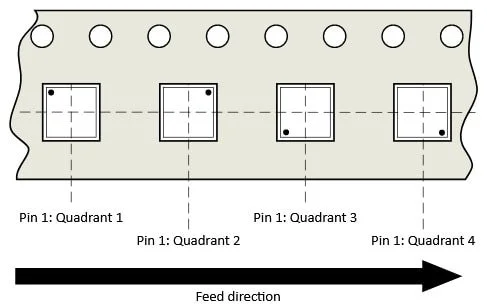
Component orientation is governed by widely adopted industry standards, most notably EIA-481, which defines carrier tape dimensions, pocket geometry, sprocket hole locations, and component orientation relative to the tape’s direction of travel.
Adhering to these standards ensures:
Compatibility across global SMT equipment platforms
Predictable machine setup and feeder alignment
Reduced risk when transitioning products between suppliers or CM sites
Standards compliance is not optional—it is critical to supply chain interoperability and long-term product reliability.
The Role of Carrier Tape and Cover Tape Materials
Material selection plays a decisive role in maintaining proper orientation throughout shipping, handling, and assembly.
Carrier tape considerations include:
Pocket geometry matched to component outline
Dimensional stability to prevent rotation or tilt
ESD-safe materials to protect sensitive devices
Cover tape requirements include:
Controlled peel force for automated removal
Anti-static properties
Secure sealing without component movement
The correct pairing of carrier tape and cover tape ensures components remain fixed in orientation from packaging through final placement.
Custom Orientation and Packaging Solutions
Not all components fit standard assumptions. Irregular shapes, asymmetric leads, polarity-sensitive devices, and custom ICs often require non-standard orientation strategies.
Service providers such as ProEx specialize in:
Custom pocket design and orientation validation
Component-specific orientation requirements
Prototype runs to confirm feeder and placement compatibility
This level of customization ensures even complex or unusual components integrate seamlessly into automated assembly environments.
Impact on Manufacturing Efficiency and Quality
Proper orientation directly contributes to:
Reduced feeder jams and mispicks
Faster machine setup and changeovers
Lower defect rates and rework
More predictable production schedules
Ultimately, orientation accuracy protects both manufacturing efficiency and end-product quality, reinforcing customer confidence and reducing total cost of ownership.
Future Trends in Component Orientation
The future of tape-and-reel orientation is driven by:
Advanced materials with improved dimensional control
Increased automation and in-line vision inspection
Data-driven process optimization and machine learning
As devices become smaller and more complex, precision in orientation will only become more critical. Staying ahead of these trends is essential for maintaining competitive advantage.
The Value of Experience and Expertise
Expertise in component orientation differentiates average service providers from strategic manufacturing partners. Deep knowledge of standards, materials, and assembly equipment enables proactive problem-solving before issues reach the production floor.
Experienced providers ensure components are:
Oriented correctly
Protected properly
Delivered ready for automated assembly
Navigating the Future with Precision in Component Orientation
Correct component orientation in tape and reel packaging is a nuanced yet critical element of modern electronics manufacturing. It requires disciplined adherence to standards, careful material selection, and proven technical expertise.
For manufacturers seeking reliable, standards-compliant, and customized tape-and-reel solutions, partnering with an experienced provider like ProEx ensures precision from packaging through placement.
Contact ProEx today to request a quote or discuss your component orientation requirements.
December 27, 2023
