Tape and Reel vs. Cut Tape: Which Should You Choose?
There are many types of packaging tape for board creation, but the types most commonly compared are tape and reel vs. cut tape packaging. In this guide we’ll cover these two packaging tape options and give proper insight on cut tape vs. tape and reel, and which applications suit each best.
At ProEx we provide EIA-481 and JEDEC compliant tape and reel packaging services. If you’re confident tape and reel packaging is right for your project you can learn more about our tape and reel services below.
If you’re still determining whether cut tape or tape and reel is right for your project, then continue reading. We’ve created this guide to let you know exactly what you need to consider to choose the right packaging for your project.
Cut tape and tape-and-reel differ in quantity and application:
Tape and reel provides a continuous strip of components on a reel, designed for high-speed automated assembly. Tape and reel prevents assembly jams, and reduces both machine down time, and operator interventions, supporting faster, more consistent production during longer runs.
Cut tape provides small strips of components for prototyping, repairs, or low-volume production. It reduces upfront cost, waste, and provides more purchasing flexibility when only a small number of parts is needed.
Cut tape is typically best for small quantities and prototypes, while tape and reel is best for high-volume automated manufacturing where efficiency is crucial.

Tape and reel packaging is a long and continuous piece of tape that's wound up into a custom cut reel. Its purpose is to deliver electronic components into a pick-and-place machine. The ultimate goal is to package small electronic components into the individual carrier tape pockets. Securing them with heat or pressure, cover tape allows the machine to rapidly populate the board.
High-quality tape and reel packaging is not only about placing components into pockets however. It also includes consistent pocket configuration, proper carrier tape selection, controlled handling, inspection, and packaging practices that support reliable automated feeding.
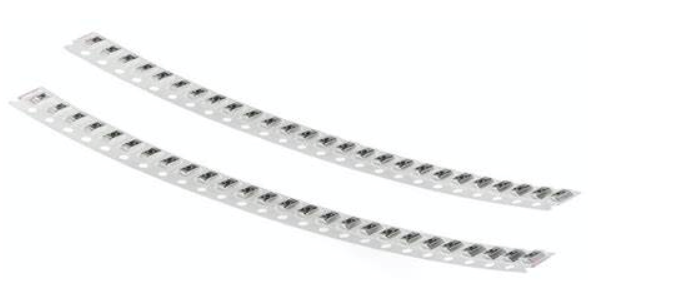
Custom cut tape packaging in electronics shares a purpose with tape and reel alternatives. The method securely delivers cut tape components to the customer but prevents the ability to automate since cut tape does not have an adequate leader and trailer. Cut tape delivers components in short, separated strips and is not designed for continuous automated feeding. As its name implies, cut tape packaging delivers components in small, cut-up pieces of tape. They are all separate from one another and the operator must hand place each piece individually.
Because of this, cut tape can be practical for engineering, sampling, and low-volume work, but less efficient when the production goal is consistent machine feeding, reduced operator handling, and faster SMT line preparation.
Which Is Better?
When it comes to tape and reel vs cut tape, tape and reel packaging is superior to cut tape for most applications. The operator only needs to feed it into the machine a single time and the tape will automatically move through it in a continuous feed. . This saves the manufacturer the hassle of hand placement and reduces the risk of human error.
Tape and reel packaging also is effective in preventing jamming. If trying to automate cut tape, it often sticks inside the feeder and jams up the machine. On the flip side, components entering the machine on a reel avoid jamming.
Automated tape and reel processes have been developed to help your components feed more smoothly into pick-and-place equipment during the downstream assembly process. Preparation services also help with the assembly process such as automated inspection of tape and reels, controlled ESD handling, and consistent packaging methods in order to provide you with assembly-ready products.
Determining Which Is Better For Your Application
When looking at which packaging method to use – tape & reel or cut tape for your products, the primary factors you'll want to take into account will include:
Quantity and Cost
Quantity and cost will play a significant role in your decision on whether to go with "Cut Tape" or "Tape and Reel" for your products. If you only require 100 or fewer pieces for prototyping, repair work, or lower volume productions, then "Cut Tape" will be the best solution.
The cut tape will also need to have a "leader" or "trailer" spliced onto it before it can run through a pick and place machine. This adds additional setup time, and depending on the quality of the splice, there can possibly be issues with feeding.
The quantity and cost benefits of cut tape are:
Keeping upfront purchasing costs lower
Reducing excess inventory
Helping you buy only the number of parts the job requires
Making small prototype, repair, or test orders more practical
Avoiding the cost of full-reel packaging when the volume does not justify it
Tape and reel assembly will typically benefit from being the best choice for quantities over 150 components. If the production run is in the range of producing hundreds or thousands of parts within one production run, then tape-and-reel assembly becomes even more valuable.
Tape-and-reel assembly methods also provide the greatest value when the costs associated with set-up (i.e., machine and assembly time) are less than the benefits derived from improving cycle time and machine loading, ensuring better quality/output consistency, less manual intervention, and better overall production flow.
The quantity and cost benefits of tape and reel are:
Making higher-volume orders easier to manage
Helping justify the cost of full-reel packaging when part counts are higher
Reducing labor costs tied to repeated manual handling
Supporting better planning for repeat or ongoing production
Making larger component orders easier to prepare for assembly
Cut tape is typically a better option for smaller orders of around 100 parts or less; tape and reel packaging becomes the preferable choice when your volume of orders reaches approximately 150 parts or more, as it is more efficient to have larger quantities of items packaged together.
If you are producing a larger quantity of components, many items will affect your quantity and costs. Once a sufficient quantity of components has been ordered to justify using tape and reel packaging for each order, delays can create additional expenses due to idle production time, rushing schedules, and slow SMT line readiness.
Standard tape and reel processing can be provided within three days or less; rush service or processing within the same business day may also be available based on lot size and intake timing.
Production Suitability
One major factor when comparing Cut Tape & Tape and Reel Packaging is the method of manufacture. In tape and reel packaging, the components are delivered in a single continuous strip and can easily move through automated pick-and-place equipment.
The most effective tape and reel services utilize fully automated taping equipment, including AATEC SA Lisa Spider systems capable of processing approximately 2500 to 3500 units per hour & V-TEK Inc. TM-500 systems able to process approximately 2000 to 4500 units per hour, depending on the size and configuration of the components.
Tape and reel are well-suited for production because it:
Feeds continuously through automated equipment
Supports pick-and-place assembly
Helps maintain consistent output during production
Reduces the need for frequent operator intervention
Ideal forl when production efficiency is a priority
Cut tape is better suited for prototyping, manual assembly, repairs, and other low-volume builds where full automation is not necessary.
Cut tape is well suited for early-stage or manual work because it:
Allows teams to order smaller part quantities
Works well before a design is ready for full production
Supports hands-on assembly, testing, and rework
Makes it easier to source parts for one-time builds
Gives teams flexibility before committing to larger production quantities
As production volume increases, tape and reel becomes the stronger option because it is built for a more consistent manufacturing process.
As production volume increases, tape and reel becomes more useful because it supports:
More predictable assembly flow
Faster machine setup after the reel is loaded
Better repeatability across production batches
Less disruption from manual part handling
A cleaner transition from component packaging to SMT assembly
Leader and Trailer
Another material difference between tape and reel and cut tape packaging is that normally there is a leader and trailer associated with the tape and reel, but not necessarily so with the cut tape. Tape and reel normally have leader tape at the beginning and a trailer at the end, assisting in feeding through automated machinery. The cut tape normally does not have as much leader and/or trailer length as compared to tape and reel, making it more difficult to load and run through a pick and place machine without additional preparation.
With tape and reel, the leader and trailer help by:
Giving the feeder enough tape to load properly
Supporting a smoother start and finish during machine feeding
Reducing setup issues at the beginning of a reel
Helping operators prepare equipment more efficiently
Making the reel easier to use in automated assembly
Cut tape may be less convenient for automated loading because it:
Often has limited extra tape at the beginning or end
May require additional preparation before machine use
Can be harder to align properly in feeders
May slow setup when parts need to be run automatically
Is not usually supplied in a format built for continuous machine loading
A significant factor affecting both setup time and risk of failure during production relates to the amount of preparation needed prior to loading components into machines. For this reason, a large proportion of manufacturers will select to use production-ready tape and reel packaging within an automated SMT environment.
Storage and Handling
In production environments, tape and reel maintain an organized supply of components that can be easily stored, handled, and loaded during the various production processes. Smaller strips of cut tape are typically delivered in a bag for smaller production runs. This is convenient for storing small amounts of components; however, it can create challenges for products requiring continuous automated handling.
The packaging of components has a significant impact on the storage, tracking, and preparation for production processes. Tape and reel services providers store and handles the components using ESD Safe and ISO certified facilities, utilizing controlled ESD handling throughout the production operation.
Tape and reel’s storage and handling benefits are:
Keeping components organized in one continuous format
Making reels easier to label, store, and retrieve
Reducing loose strips or small bags in production areas
Helping protect parts during storage and movement
Making repeat production handoffs easier to manage
Cut tape can still be practical for storage and handling when:
Only a small number of parts need to be stored
Parts are being used quickly for a prototype or repair
Short-term flexibility matters more than long-term organization
The job does not require repeated production handling
The components can be managed in small strips or protective packaging
The organized storage and repeating production of Tape & reel provides an improved inventory management system than cut tape for manufacturers who produce continuously. Tape & reel can also help ensure a clean and smooth handoff between the warehouse and the SMT line, and eliminate many of the potential problems associated with manual handling of electronic components.
In addition to storing and handling components using tape & reel, it is also increasingly relevant in manufacturing as electronic components must meet standards, require inspection, provide ESD protection, be available in specific formats, have specific geometries, and be ready for automated SMT assembly.
Splicing Considerations
Cut tape may need to be spliced to a leader or trailer before it can run through a pick-and-place machine. This extra preparation can increase setup time and may create feeding issues if the splice is not done properly.
Splicing can create extra setup work because it:
Adds another preparation step before production
Requires careful alignment with the leader or trailer
Can affect feeder reliability if the splice is not clean
May slow down machine setup
Creates another point where handling errors can occur
Cut tape can still be a good option when:
The job does not require automated feeding
The part quantity is too small to justify full reel preparation
The components will be placed manually
The order is for testing, repair, or sampling
Extra setup time is acceptable for the size of the job
Tape and reel avoids many splicing concerns because it:
Arrives prepared for continuous feeding
Reduces the need for added leader or trailer preparation
Makes machine loading more straightforward
Helps avoid splice-related feeder issues
Supports a cleaner setup process for automated assembly
While cut tape may be appropriate for smaller jobs, splicing requires an additional amount of set-up time during automated manufacturing processes, as opposed to using tape-and-reel (tape-and-reel will give you smoother feeding of materials and may allow for a faster set-up time than if you had to splice together pieces of cut tape).
In industrial assembly operations where component feeder performance is critical, properly prepared tape-and-reel will eliminate most of the need for additional preparation time and improve the flow of components into an automated assembly line.
Best Use Cases by Industry
Cut tape is often the better choice for industries and jobs that need small quantities of parts rather than full production volumes.
Cut tape is often used for:
Electronics prototyping: early board builds, design testing, and proof-of-concept work
Product development: small pilot runs before moving into full production
Repair and rework: replacing a limited number of damaged or missing components
Research and lab testing: evaluating components without ordering full reels
Specialty manufacturing: short custom runs with limited part requirements
Tape and reel is usually the better choice for industries that depend on repeat production, automated assembly, and consistent packaging standards.
Tape and reel is often used for:
Electronics manufacturing: automated assembly and EIA-481 compliant packaging
Automotive electronics: programmed and packaged components for ECU, PCU, ISU, and other smart systems
Medical electronics: packaging that must support consistency and quality control
Military and aerospace: controlled packaging for components that must meet strict requirements
Semiconductor production: programming, packaging, and value-added component services
Tape & Reel is an ideal manufacturing solution in the following industries: Semiconductor manufacturing, Automotive, Aerospace and Military, Electronics manufacturing, and Medical Device manufacturers.
How The Tape and Reel Process Provides More Production Support
Tape & Reel provides producers with additional levels of production help by converting materials from bulk packaging into a more user-friendly format for quality inspection, handling, loading, and automated assembly of components. This is significant because the purpose of the Tape & Reel process goes beyond merely placing an assembly or part on a mechanical device; the intention is also to prepare it for a stable and more uniform production process.
Materials and Configuration Support
There are a number of different materials that can be used for carrier tapes. Three commonly used materials are: paper, PS (polystyrene), and PC (polycarbonate).
The use of different materials is important as different components and production environments will require different materials for carrier tape to achieve proper protection, correct pocket fit, and enable automated handling of the components.
Carrier tape width and reel configuration must be in accordance with the requirements of automated SMT (surface mount technology) compatible production.
V-TEK TM-500 can accommodate carrier tape widths from approximately 8mm to 56mm, and component sizes down to a minimum of approximately 2mm x 2mm, according to the manufacturer's specifications.
Custom tooling solutions are also available for components that have a unique or non-standard geometry or have special requirements for pockets.
Inspection and Quality Assurance
The difference between basic packaging and ready-to-produce tape and reel services is mainly based on their inspections. Tape and reel service providers can perform 2D and 3D inspections and reports via automation in order to maintain accuracy, consistency, and quality control.
In performing the 2D inspection, high-resolution images of each component are inspected to determine how the components are oriented, placed, and how their surfaces look.
In performing the 3D optical inspection, scanners will take pictures from many different angles of the device, create a three-dimensional representation of it, use that to confirm measurements, and to check if there are any bent leads or coplanarity issues.
Performing this type of inspection is extremely important in a production environment where small issues in either packaging or placement can turn into significant issues after the components are placed on the SMT production line.
What a Production-Ready Tape and Reel Workflow Looks Like
A professional tape and reel process should make components easier to inspect, package, verify, and ship with documented control.
This structured workflow does just that: Intake → 2D/3D Inspection → Tape & Seal → Final QA & Reporting → Pack → Ship.
This workflow supports consistent throughput, documented process control, and better confidence before components move into downstream assembly.
For manufacturers, this means tape and reel is not just a packaging choice. It is part of a broader production-readiness strategy.
Your Production Needs Determine Which Is Better
The question "Which method is better - cut tape or tape and reel?" depends on your needs for quantity, production method, and how you plan to handle the parts. Cut tape makes sense when you're looking for a small number of parts to use for testing and prototyping, replacing parts, or short-term applications. You can lower your up-front costs and get more flexibility when full production volumes are not necessary.
When you need to have the parts run through automation (machines) for assembly, or for repeat production runs, or higher volume production, tape and reel will be the better choice. Tape and reel will allow for more efficient feeding of parts into the machine and require a smaller amount of manual handling than cut tape. Tape and reel parts move through SMT equipment more consistently with less possibility of loss or damage, and tape and reel parts are more organized, which creates a smoother transition from inspection to packaging to loading into the machine, compared to cut tape.
ProEx is committed to providing you with orders that meet EIA 481 and JEDEC tape and reel packaging standards. That's why we offer custom tooling, same-day processes, and 3D inspection and reporting to ensure that your boards are free of defects.